

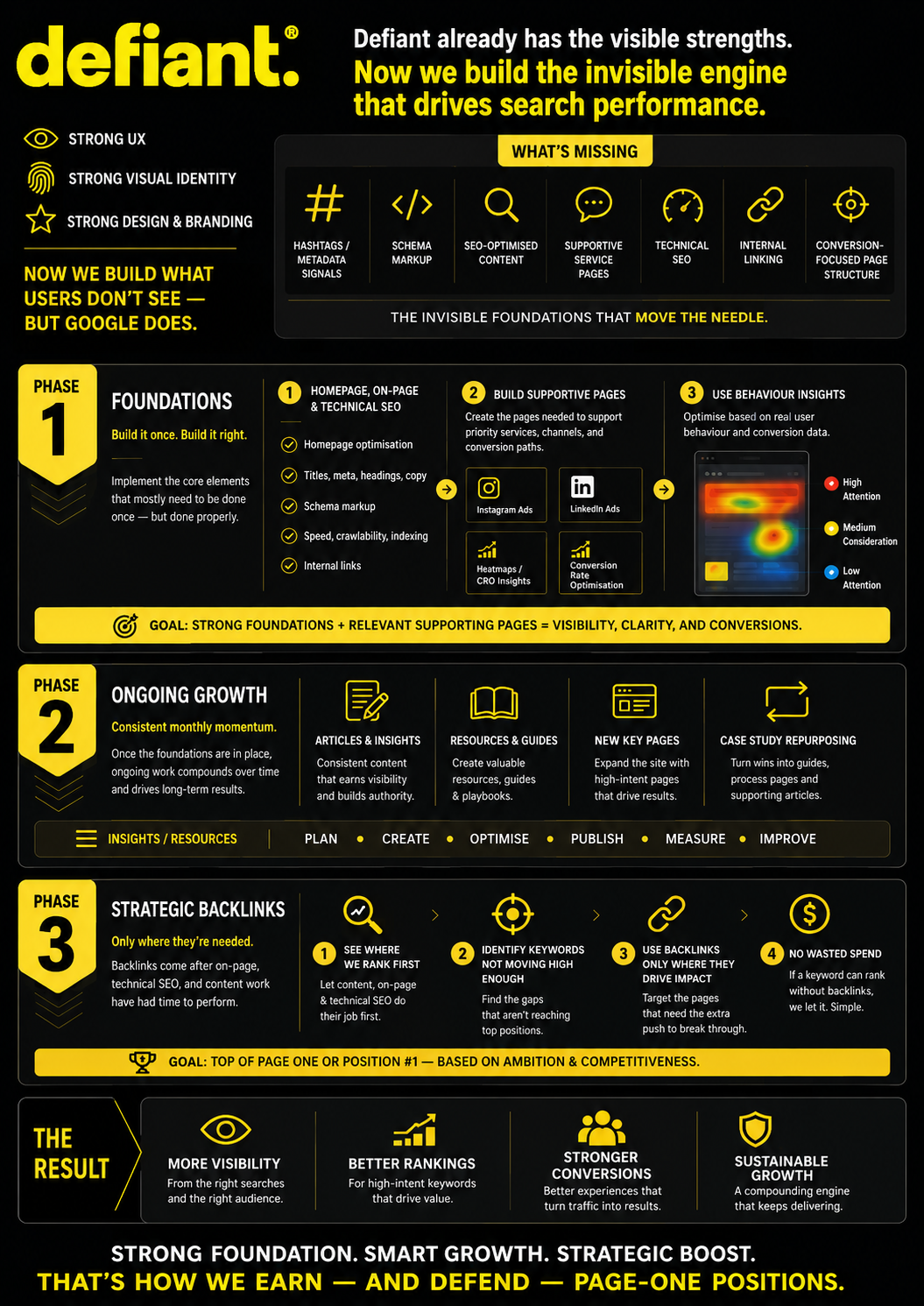
Defiant already has the visible strengths. Now we build the invisible engine.
Defiant already has strong UX, strong visuals, strong design and strong branding. The next layer is the SEO infrastructure, content and conversion architecture that users may not see immediately — but Google does.
Improved discoverability, targeting and contextual relevance.
Structured data that helps search engines understand the website.
Search-focused content that still feels useful, human and on brand.
Pages for every key service, channel and conversion path.
Speed, crawlability, indexability, Core Web Vitals and site health.
Stronger relevance signals between priority pages and content hubs.
Foundations
Build it once. Build it right.
The foundation: implement what moves the needle
The first phase is about putting the core SEO assets in place: homepage optimisation, on-page SEO, technical SEO, schema, internal links, supportive service pages and behaviour-led improvements.
Homepage, on-page and technical SEO
- Homepage optimisation
- Titles, meta descriptions and headings
- SEO-focused content improvements
- Schema markup
- Speed, crawlability and indexing
- Internal links
- Core Web Vitals and mobile optimisation
Build supportive pages
Create pages for important services, channels and conversion paths so Defiant has the right SEO assets for every search intent.
Use behaviour insights
Use heatmaps and conversion data to understand what users see, where they click and what needs to be improved.
Ongoing growth
Consistent monthly momentum.
Ongoing work: grow, optimise and expand
Once the foundation is in place, the work shifts into a consistent monthly rhythm: useful articles, new resources, additional key pages, internal links, optimisation and better use of case studies.
Articles and insights
Consistent content around topics that matter and support commercial intent.
Resources and guides
Create valuable resources, guides, playbooks and explainers.
New key pages
Expand the site with high-intent pages and stronger site sections.
Case study repurposing
Turn case studies into guides, articles, process pages and support content.
Strategic backlinks
Only where they are needed.
Backlinks: only after the foundations are strong
Backlinks should come after on-page, technical and content work has had time to perform. We first see what ranks naturally, then use backlinks only for keywords that need the extra push.
See where we rank first
Let content, on-page SEO and technical SEO do their job first.
Identify keyword gaps
Find terms that are not moving high enough or reaching top positions.
Target strategically
Use backlinks only where they drive the extra push.
No wasted spend
If a keyword can rank number one without backlinks, we let it.
From the right searches and the right audience.
For high-intent keywords that drive value.
Better experiences that turn traffic into results.
A compounding engine that keeps delivering over time.